
The Smoky Mountains are genuinely extraordinary. Great Smoky Mountains National Park is the most visited national park in the country and for good reason. The mountains are spectacular, the wildlife is real, and the experience of being in an ancient mountain range with 800 miles of hiking trails is something most of Ohio and the Midwest can’t easily replicate.
It’s also a two-state traffic problem on a Friday afternoon in October, a cabin market that can be opaque and inconsistent in quality, and a drive that runs 7–10 hours from central Ohio depending on where you start.
Hocking Hills doesn’t compete with the Smokies in scale. What it competes on – and consistently wins – is the combination of quality, proximity, and value for Ohio, Indiana, Michigan, and Pennsylvania families who want the cabin-in-the-woods experience without the logistical commitment.
The Drive Comparison
From Columbus: Hocking Hills is roughly 1–1.5 hours. The Smoky Mountains are 7–8 hours to Gatlinburg or Cherokee.
From Cleveland: Hocking Hills is 2.5 hours. The Smoky Mountains are 9–10 hours.
From Indianapolis: Hocking Hills is 2.5 hours. The Smoky Mountains are 6–7 hours.
From Pittsburgh: Hocking Hills is 3 hours. The Smoky Mountains are 8–9 hours.
The drive difference isn’t just about time – it’s about the whole trip equation. A 1.5-hour drive means you can leave Friday afternoon and arrive before dinner. A 7-hour drive means you’re losing most of Friday to transit, arriving exhausted, and starting the trip at a deficit. For families with kids, the difference is significant. For groups coordinating multiple cars and schedules, it’s the difference between a trip people actually want to do and one they agree to in principle but keep finding reasons to postpone.
The Natural Beauty Comparison
The Smokies have elevation — real mountain topography with peaks above 6,000 feet and the mist and cloud cover that gives the range its name. It’s a different category of landscape from Hocking Hills, and it’s not worth pretending otherwise.
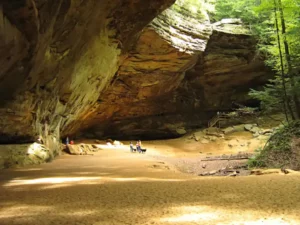
What Hocking Hills has is gorge geology that’s genuinely singular. The sandstone cave and gorge system — formed over 350 million years — produces a landscape that looks like nothing else in the Midwest. The caves, waterfalls, and cliff formations are enclosed, dramatic, and intimate in a way that open mountain landscapes aren’t. You’re inside the landscape, not looking at it from a distance.
Hocking Hills State Park draws over 4 million visitors annually — a number that reflects genuine, sustained demand, not just regional loyalty. A 2023 study found the area gained popularity faster than almost any other state park in the country based on web search data. People who visit keep coming back, and people who hear about it go.

In fall, Hocking Hills competes directly with the Smokies on foliage. The gorge trails in October frame fall color in a way that mountain overlooks can’t — you’re walking through the canopy, not looking at a hillside from the road.
The Cost Comparison
The Smoky Mountains cabin market is driven partly by the tourism scale of the region — Gatlinburg alone hosts millions of visitors and has a full resort economy around it. Cabin rates in peak season can run high, and the Airbnb and VRBO service fees add another 12–16% on top of the nightly rate.
The Hocking Hills cabin market runs at lower price points with comparable quality. Reflections Hocking Hills cabins start from $185/night for a 4-guest cabin and top out around $290/night for a 12-guest cabin — rates that represent strong value relative to comparable quality in the Smokies, particularly when you factor in the fuel savings from a shorter drive.
And because Reflections offers direct booking with up to 18% savings versus Airbnb, the price gap between Hocking Hills and the Smokies widens further when you book direct. No platform fees, same private cabin, shorter drive.
The Crowd Comparison
Great Smoky Mountains National Park’s 13 million annual visitors produce visible congestion at popular trailheads, traffic backups on the main scenic routes, and a competitive cabin market that rewards booking 6–12 months out for peak weekends.
Hocking Hills at 4 million annual visitors has its own crowd considerations — Old Man’s Cave on a Saturday morning in October is genuinely busy — but the scale is different. Midweek trips are significantly quieter. Less-visited areas like Cantwell Cliffs, Boch Hollow, and Broken Rock Falls are rarely crowded. And the trail system, while not comparable in total mileage to the Smokies, offers enough variety that groups can distribute themselves without feeling like they’re all on the same conveyor belt.
The Practical Edge Cases
Wildlife: The Smokies have black bears, elk, white-tailed deer, and red wolves. Hocking Hills has deer, foxes, wild turkeys, and diverse bird populations.
Airport access: For groups flying in, Chattanooga (TN) and Knoxville (TN) serve the Smokies. Columbus (CMH) or Dayton (DAY) serve Hocking Hills. Both regions are primarily drive-to destinations for most Midwest visitors.
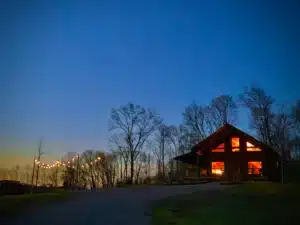
Pet-friendly options: Reflections Hocking Hills has two pet-friendly properties — Shurtz Overlook and Sky Vista. Dogs welcome.
Summary
The Smoky Mountains win on scale, elevation, and wildlife. Hocking Hills wins on proximity for the Midwest, intimacy of the gorge landscape, value, and the ability to pull off a genuinely excellent trip without a full week and a 15-hour round-trip drive.
For Ohio, Indiana, Michigan, and western Pennsylvania families choosing between the two: the trip that actually happens is better than the trip that stays in the planning phase. Hocking Hills happens. Browse the Reflections cabins and book direct – up to 18% savings versus Airbnb, and a two-hour drive that doesn’t require an out-of-office email.